

Hoạt động
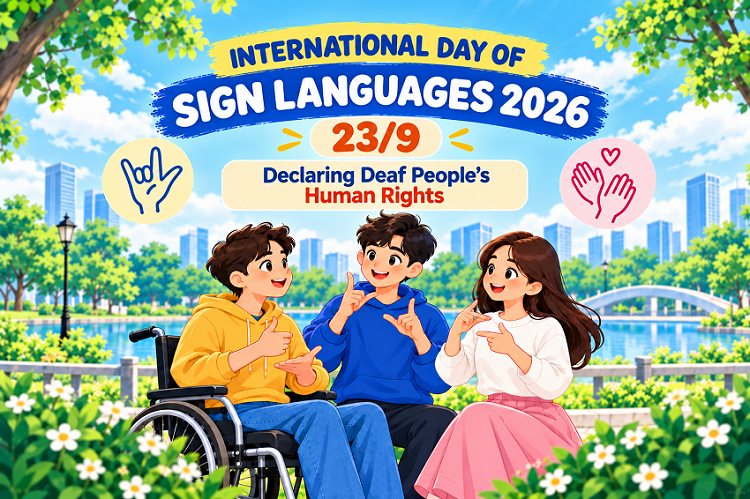
The International Day of Sign Languages on September 23, 2026, under the theme “Declaring Deaf People’s Human Rights,” emphasizes the need to promote sign language rights, accessibility, and equal participation so that these rights become a reality in all areas of life.
The year 2026 is a particularly significant one for the global Deaf community. It marks both the 20th anniversary of the United Nations Convention on the Rights of Persons with Disabilities (CRPD) and the 75th anniversary of the founding of the World Federation of the Deaf (WFD). These milestones provide an opportunity to reflect on the progress made while renewing efforts to ensure that the human rights of Deaf people are fully realized in practice.
From Rights recognized to rights realized
The United Nations officially recognized the International Day of Sign Languages in 2017, and it has been observed annually on September 23 ever since. The day raises awareness of the vital role of sign languages in ensuring the full realization of Deaf people's human rights. September 23 also marks the date on which the WFD was founded in 1951.
In 2026, The International Day of Sign Languages is observed under the theme “Declaring Deaf People’s Human Rights”. The theme goes beyond simply recognizing rights. It calls on governments, organizations, and communities to turn those rights into reality in every area of life, including by ensuring full access through national sign languages.
According to the WFD, The International Week of Deaf People 2026 will take place from September 21 to 27 under the same overarching theme. Each day focuses on a different aspect of human rights, including national sign languages, inclusive education, accessibility, the participation of Deaf people in decision-making, and the right to Deaf culture.
Sign Language is a Human Right
Sign language is not simply a system of signs used as a substitute for spoken language. The United Nations recognizes sign languages as fully developed natural languages, with their own linguistic structures that differ from those of spoken languages. More than 70 million Deaf people worldwide belong to communities that use sign languages, and more than 300 sign languages are currently in use.
The CRPD recognizes and promotes the use of sign languages and affirms their equal status with spoken languages. It also requires nations to facilitate the learning of sign language and promote the linguistic identity of the Deaf community.
This is particularly important for ensuring accessibility for Deaf people. Without sign language and services delivered in sign language, Deaf people may continue to face significant barriers to education, information, healthcare, public services, employment, and participation in social life.
For this reason, the right to sign language is not an optional or supplementary need; it is a fundamental component of Deaf people's ability to exercise and enjoy their human rights fully.
20 Years of the CRPD: From International Commitments to Change in Everyday Life
The year 2026 marks 20 years since the adoption of the CRPD. Over the past two decades, the Convention has helped advance a human rights-based approach to disability, placing dignity, equality, autonomy, accessibility, and full participation in society at its center.
For Deaf people, the recognition and realization of sign language rights are directly connected to many of the rights enshrined in the Convention, including the rights to accessibility and education, participation in society, and the protection of cultural and linguistic identity.
The 20th anniversary of the CRPD is therefore not only an opportunity to reflect on progress in policies and legislation. It is also a chance to confront the gap between rights recognized and rights realized.
75 Years of the WFD: Advancing the Rights of Deaf People
On September 23, 1951, the WFD was founded in Rome, Italy. Seventy-five years later, the organization continues to advance the human rights of Deaf people around the world, including by protecting and promoting the recognition of sign languages.
The WFD's 75th anniversary in 2026 is therefore more than a historical milestone. It is an opportunity for the international community to reaffirm that the rights of Deaf people are human rights, and that the progress made must be translated into meaningful, tangible changes in people's lives.
The WFD continues to champion the principle “Nothing About Us Without Us”, emphasizing that Deaf people must be at the center of decisions and policies that affect their lives.
Towards a Truly Inclusive Society
An inclusive society should not be measured solely by whether rights have been recognized in laws and policies. It should also be measured by whether people can actually exercise and enjoy those rights in their daily lives.
For Deaf people, this means ensuring access to information and services through national sign languages; providing meaningful opportunities to learn in appropriate educational environments; enabling equal participation in social life; and ensuring that Deaf people have a genuine voice in developing the policies and decisions that affect them. The WFD emphasizes that meaningful accessibility for Deaf people cannot be separated from access to national sign languages.
The 20th anniversary of the CRPD and the 75th anniversary of the WFD are milestones that invite us to recognize how far we have come-and to remember how much work remains.
On the International Day of Sign Languages, September 23, 2026, ACDC, together with the Deaf community, organizations of and for persons with disabilities, government agencies, institutions, and partners, continues to work towards a society in which sign languages are respected, the rights of Deaf people are upheld, and everyone has an equal opportunity to participate fully in social life.
Declaring Deaf People’s Human Rights - from commitment to action, from rights recognized to rights realized.
-------------------------------------
International Day of Sign Languages Themes Over the Years
|
Year |
English Theme |
Vietnamese Theme |
|
2018 |
With Sign Language, Everyone is Included! |
Ngôn ngữ kí hiệu, tất cả cùng hòa nhập |
|
2019 |
Sign Language Rights for All! |
Quyền Ngôn ngữ ký hiệu cho tất cả! |
|
2020 |
Sign Languages are for Everyone! |
Ngôn ngữ ký hiệu dành cho tất cả mọi người! |
|
2021 |
We Sign for Human Rights! |
Chúng ta ký hiệu vì quyền con người! |
|
2022 |
Sign Languages Unite Us! |
Ngôn ngữ ký hiệu gắn kết chúng ta! |
|
2023 |
A World Where Deaf People Everywhere Can Sign Anywhere! |
Một thế giới nơi tất cả người Điếc đều có thể ký hiệu |
|
2024 |
Sign Up for Sign Language Rights |
Chung tay Hành động lan tỏa ngôn ngữ ký hiệu |
|
2025 |
No Human Rights Without Sign Language Rights |
Không có quyền con người nếu không có quyền ngôn ngữ ký hiệu |
|
2026 |
Declaring Deaf People’s Human Rights |
Khẳng định quyền con người của người Điếc |