

Hoạt động
The theme is chosen by the Vietnam Federation on Disability for this year's National Day of Persons with Disabilities on April 18, 2025, is: "Digital technology and accessibility for persons with disabilities".
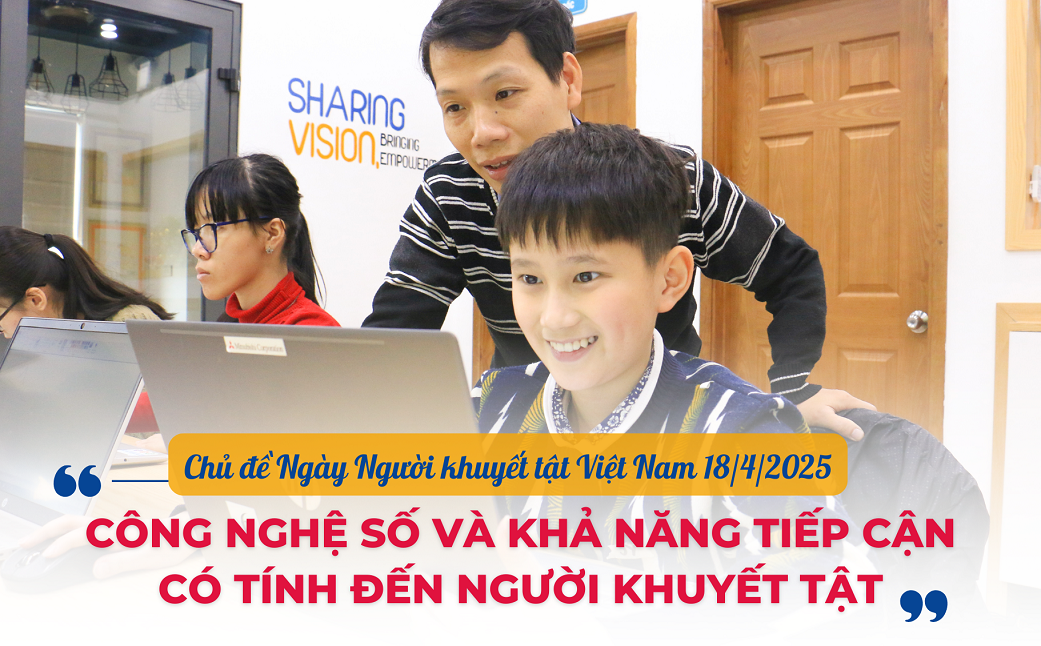
Theme of Vietnam’s National Day of Persons with Disabilities 2025: “Digital Technology and Accessibility for Persons with Disabilities”
April 18 is designated as Vietnam’s National Day of Persons with Disabilities under the Law on Persons with Disabilities. This year, the Vietnam Federation on Disability has selected the theme “Digital Technology and Accessibility for Persons with Disabilities”. In the digital era, technology has become a vital tool, enabling people, including those with disabilities and other vulnerable groups, to access information, education, employment, and socio-economic activities more easily. However, not all persons with disabilities in Vietnam or globally can fully utilize the benefits of technology. The application of technology offers tremendous opportunities for better societal integration for many individuals with disabilities. For example, on April 1, 2025, Vietnam Television officially introduced sign language interpretation for persons with hearing and speech impairments on the VTVgo platform, replacing the previous nightly 10 PM news broadcast on VTV2.
This year, the Vietnam Federation on Disability emphasizes two key objectives under this theme:
1. Promoting the Use of Technology to Enhance Access to Information, Education, and Employment for Persons with Disabilities
Persons with disabilities, particularly those with visual or hearing and speech impairments, face significant challenges in accessing information on online platforms. Older platforms were often inaccessible for visually impaired individuals due to the lack of software or applications for converting content into sign language. Thanks to advancements in digital technology, tools such as text-to-speech software, speech-to-text applications, and sign language conversion programs have made information more accessible.
According to the 2023 National Survey on Persons with Disabilities by the General Statistics Office, the enrollment rate of children with disabilities lags behind that of their non-disabled peers. Only 68.1% of children with disabilities attend primary school compared to 95.2% of non-disabled children, with the gap widening at higher education levels. Barriers in education stem from inadequate infrastructure, inaccessible teaching materials, and other limitations. Technology in education opens new learning opportunities for children with disabilities through accessible platforms like online learning and easy-to-read digital materials, replacing traditional printed texts. Before the rise of information technology, remote work was nearly impossible for persons with disabilities. However, since the development of IT, particularly post-COVID-19, technology has bridged the gap to employment. Persons with disabilities can now work remotely, use assistive software for communication, and leverage artificial intelligence to enhance work quality. Many IT companies have successfully employed persons with disabilities, demonstrating their effectiveness in the workforce.
2. Promoting the Development of Accessible Online Environments and Digital Services:
Conclusion
Digital technology is not only a convenience but also a key to unlocking opportunities for inclusion and development for persons with disabilities. Creating an accessible digital environment empowers vulnerable groups and fosters a sustainable, equitable society. It is a collective responsibility for both public and private sectors to leverage technology to build a truly barrier-free digital world where everyone can access knowledge, employment opportunities, and realize their full potential.
Key Activities to Implement the Theme:
To realize the theme “Digital Technology and Accessibility for Persons with Disabilities”, individuals, organizations, and communities can contribute through practical actions:
Raising Awareness and Shifting Mindsets
Concrete Actions by Organizations and Businesses
Community Engagement and Events
Call to Action
Every contribution, no matter how small, helps build a civilized society where digital technology serves as a bridge for inclusion and equality. Let’s work together to break down barriers, ensuring no one is left behind in Vietnam’s digital transformation journey!
Hanoi, April 2, 2025
Nguyen Thi Lan Anh, M.A. Vice President Vietnam Federation on Disability
[1] https://www.facebook.com/share/p/16PYU2eaQN/ [2] Terms and definitions in this article comply with Vietnam’s Law on Persons with Disabilities.