



From "care" to "Inclusion": Key highlights of the master plan for the implementation of the program for assistance to persons with disabilities for the 2026 - 2030 period

176 Lượt xem
14/08/2026
Loan Nguyễn
0
Audio

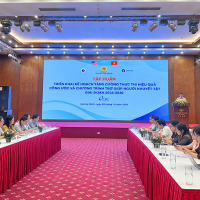
On August 11, 2026, the Ministry of Health issued Decision No. 2559/QD-BYT on the Master Plan for the implementation of the Program for Assistance to Persons with Disabilities for the 2026–2030 period. The Plan concretizes the objectives of the Program for Assistance to Persons with Disabilities for the 2021–2030 period, while strengthening the implementation of the United Nations Convention on the Rights of Persons with Disabilities (CRPD) and relevant recommendations of the Committee on the Rights of Persons with Disabilities. Key highlights include:

Shifting the focus from “healthcare and care” to “society and inclusion”

The Plan emphasizes shifting social perceptions of disability from a “healthcare and care” approach to a “social and inclusion” approach. Accordingly, communication efforts will focus on eliminating stigma, reducing inequalities, expanding opportunities and empowering persons with disabilities to participate in and contribute equally to social development. At the same time, the Plan aims to create a barrier-free environment, ensure the legitimate rights and interests of persons with disabilities, enable their equal participation in social activities and support them in realizing their full potential.

Key targets by 2030

The Plan sets out a range of specific targets across essential areas, notably:

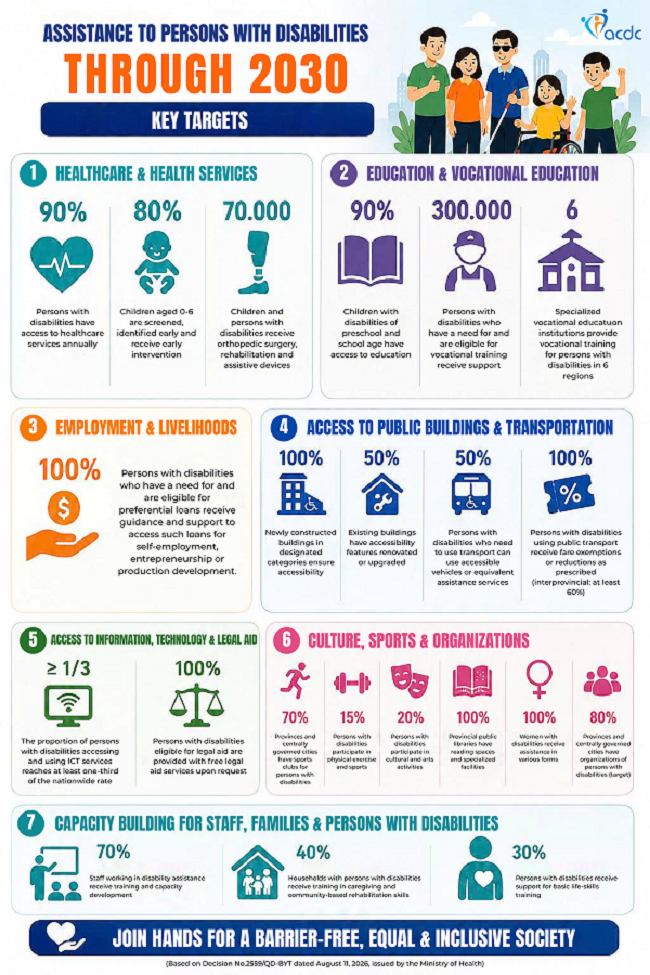
  • Approximately 90% of persons with disabilities will have access to healthcare services annually; approximately 70,000 children and persons with disabilities will receive orthopedic surgery, rehabilitation and appropriate assistive devices.
  • 90% of children with disabilities of preschool and school age will have access to education; 300,000 persons with disabilities who have a need for and are eligible for vocational training will receive support.
  • 100% of persons with disabilities who have a need for and are eligible for preferential loans will receive guidance and support to access such loans for self-employment, entrepreneurship or production development.
  • 100% of newly constructed buildings covered by the Plan will meet accessibility requirements; 50% of existing buildings will have their accessibility features renovated or upgraded.
  • 100% of persons with disabilities eligible for legal aid will be provided with free legal aid upon request.
  • The Plan aims for 80% of provinces and centrally governed cities to have organizations of persons with disabilities.

Strengthening data on persons with disabilities

The Plan also places emphasis on strengthening the management, collection and integration of data on persons with disabilities, including the development of software for registering and managing information on persons with disabilities. For women with disabilities, the Plan calls for the development of disaggregated databases, including data by sex, age, type of disability and other relevant characteristics. More comprehensive and detailed data will help better identify the needs and barriers faced by different groups of persons with disabilities, providing a basis for developing and implementing more appropriate policies.

Promoting universal accessibility and gradually removing barriers

The Plan sets out a range of tasks to promote accessibility, including the development of Universal Accessibility Transport Criteria, a Handbook on Accessible Transport Facility Design, and the promotion of standards and technical regulations on accessibility in information and communications technology.

Notably, communication products are required to incorporate sign language, subtitles, Braille and accessible digital formats that are easy to access, read and understand, ensuring that people with different types of disabilities can access information.

From changing perceptions and strengthening data to removing barriers, the Plan aims to expand opportunities for persons with disabilities to participate equally and achieve fuller inclusion in social life./.

Take a look at the infographic below to learn more about the key targets for assistance to persons with disabilities by 2030:
Alternatively, you can view the full information in a clearer, high-resolution PDF via the link below: Assistance to persons with disabilities by 2030.

Translator: Nguyen Dac Thanh 
0/5
(0 nhận xét)
5
0%
4
0%
3
0%
2
0%
1
0%

Đánh giá cả bạn về From "care" to "Inclusion": Key highlights of the master plan for the implementation of the program for assistance to persons with disabilities for the 2026 - 2030 period

Tin liên quan

Thành phố Huế: Hoàn thành đóng ca can thiệp phục hồi chức năng cho người khuyết tật và nạn nhân da cam
Đăng Quyến
126 27/08/2026

Thành phố Huế: Hoàn thành đóng ca can thiệp phục hồi chức năng cho người khuyết tật và nạn nhân da cam

Trong các ngày 15 - 16/8 và 22 - 23/8/2026, Viện Nghiên cứu phát triển cộng đồng (ACDC) phối hợp với Hội Người khuyết tật – Bảo trợ người khuyết tật và trẻ mồ côi thành phố Huế, Bệnh viện Phục hồi chức năng thành phố Huế, chính quyền địa phương và các Trạm Y tế tổ chức hoạt động đóng ca can thiệp phục hồi chức năng (PHCN) tại nhà cho 78 người khuyết tật và nạn nhân da cam. Hoạt động nằm trong khuôn khổ dự án “Hỗ trợ sinh kế và nâng cao chất lượng cuộc sống cho người khuyết tật, nạn nhân chất độc da cam tại thành phố Huế”, do Tổ chức Green Cross Switzerland (GCCH) tài trợ thông qua ACDC.
86 người khuyết tật và nạn nhân da cam được cấp phát chân, tay giả và dụng cụ chỉnh hình tại thành phố Huế
Đăng Quyến
158 14/08/2026

86 người khuyết tật và nạn nhân da cam được cấp phát chân, tay giả và dụng cụ chỉnh hình tại thành phố Huế

Ngày 13 - 14/8/2026, Viện Nghiên cứu phát triển cộng đồng (ACDC) đã phối hợp với Hội Người khuyết tật – Bảo trợ người khuyết tật và Trẻ mồ côi thành phố Huế cùng các đơn vị liên quan hoàn thành hoạt động cấp phát chân, tay giả và dụng cụ chỉnh hình cho 86 người khuyết tật và nạn nhân da cam tại 11 xã, phường trên địa bàn thành phố Huế. Đây là hoạt động tiếp nối sau quá trình thử mẫu chân tay giả, dụng cụ chỉnh hình được triển khai vào tháng 7/2026. Hoạt động này thuộc dự án “Hỗ trợ sinh kế và nâng cao chất lượng cuộc sống cho người khuyết tật, nạn nhân chất độc da cam tại thành phố Huế” do Tổ chức Green Cross Switzerland (GCCH) tài trợ thông qua ACDC. 
Quảng Trị: Khảo sát, đánh giá nhu cầu hỗ trợ bữa ăn bán trú và trang thiết bị phục hồi chức năng
Bùi Thạch
178 13/08/2026

Quảng Trị: Khảo sát, đánh giá nhu cầu hỗ trợ bữa ăn bán trú và trang thiết bị phục hồi chức năng

Trong hai ngày 08/8 và 11/8/2026, Viện Nghiên cứu phát triển cộng đồng (Viện ACDC) đã phối hợp chặt chẽ với Hội Người khuyết tật, Nạn nhân da cam, Bảo trợ người khuyết tật và Bảo vệ quyền trẻ em tỉnh Quảng Trị tổ chức khảo sát, đánh giá nhu cầu hỗ trợ bữa ăn bán trú và trang thiết bị phục hồi chức năng tại các trung tâm, cơ sở phục hồi chức năng, chăm sóc, giáo dục cho người khuyết tật, nạn nhân da cam. Chuyến khảo sát nhằm đánh giá thực trạng, xác định nhu cầu hỗ trợ và làm cơ sở triển khai các nội dung trong giai đoạn tiếp theo của Dự án. Đoàn đã có chuyến khảo sát, đánh giá thực tế tại 06 trung tâm, trường giáo dục chuyên biệt trên địa bàn tỉnh.