


Activity

On August 11, 2026, the Ministry of Health issued Decision No. 2559/QD-BYT on the Master Plan for the implementation of the Program for Assistance to Persons with Disabilities for the 2026–2030 period. The Plan concretizes the objectives of the Program for Assistance to Persons with Disabilities for the 2021–2030 period, while strengthening the implementation of the United Nations Convention on the Rights of Persons with Disabilities (CRPD) and relevant recommendations of the Committee on the Rights of Persons with Disabilities. Key highlights include:
Shifting the focus from “healthcare and care” to “society and inclusion”
The Plan emphasizes shifting social perceptions of disability from a “healthcare and care” approach to a “social and inclusion” approach. Accordingly, communication efforts will focus on eliminating stigma, reducing inequalities, expanding opportunities and empowering persons with disabilities to participate in and contribute equally to social development. At the same time, the Plan aims to create a barrier-free environment, ensure the legitimate rights and interests of persons with disabilities, enable their equal participation in social activities and support them in realizing their full potential.
Key targets by 2030
The Plan sets out a range of specific targets across essential areas, notably:
Strengthening data on persons with disabilities
The Plan also places emphasis on strengthening the management, collection and integration of data on persons with disabilities, including the development of software for registering and managing information on persons with disabilities. For women with disabilities, the Plan calls for the development of disaggregated databases, including data by sex, age, type of disability and other relevant characteristics. More comprehensive and detailed data will help better identify the needs and barriers faced by different groups of persons with disabilities, providing a basis for developing and implementing more appropriate policies.
Promoting universal accessibility and gradually removing barriers
The Plan sets out a range of tasks to promote accessibility, including the development of Universal Accessibility Transport Criteria, a Handbook on Accessible Transport Facility Design, and the promotion of standards and technical regulations on accessibility in information and communications technology.
Notably, communication products are required to incorporate sign language, subtitles, Braille and accessible digital formats that are easy to access, read and understand, ensuring that people with different types of disabilities can access information.
From changing perceptions and strengthening data to removing barriers, the Plan aims to expand opportunities for persons with disabilities to participate equally and achieve fuller inclusion in social life./.
Take a look at the infographic below to learn more about the key targets for assistance to persons with disabilities by 2030:
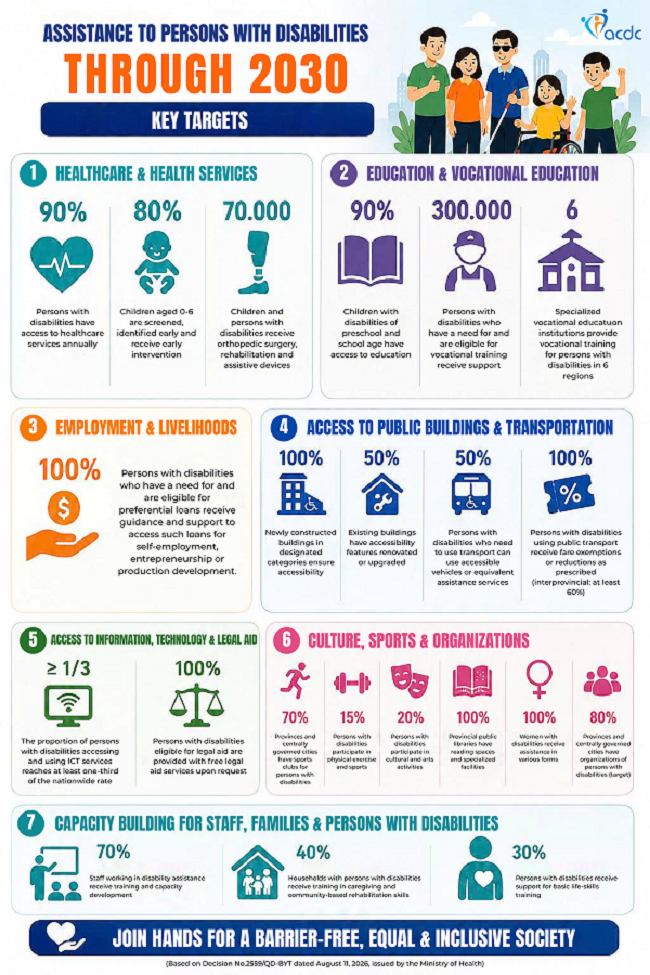
Alternatively, you can view the full information in a clearer, high-resolution PDF via the link below: Assistance to persons with disabilities by 2030.
Translator: Nguyen Dac Thanh