

Story of Change

After more than four decades living with the consequences of a landmine accident, Ms. Dong can now feel the changes in every step she takes. These steps not only make it easier for her to move around, but also restore her confidence and bring a sense of renewed support after many years of quiet endurance.
At the age of 17, Ms. Nguyen Thi Dong (born 1965), who lives in Huong Thuy ward, Hue city, experienced a life-changing landmine accident resulting in the loss of two-third of her right leg. From a young woman in her working years, she had to adapt to a new life with mobility limitations. For many years after the accident, her life mostly revolved around her small home, where she lives with her son, daughter-in-law, and grandchildren. The tasks she could take on were mainly limited to housework and caring for her grandchildren.
Recalling the incident, she shared simply: “When I was 17, I experienced a landmine accident and lost part of my leg. Since then, I haven’t been able to do heavy work. Now I stay at home, do housework, and take care of my grandchildren.”
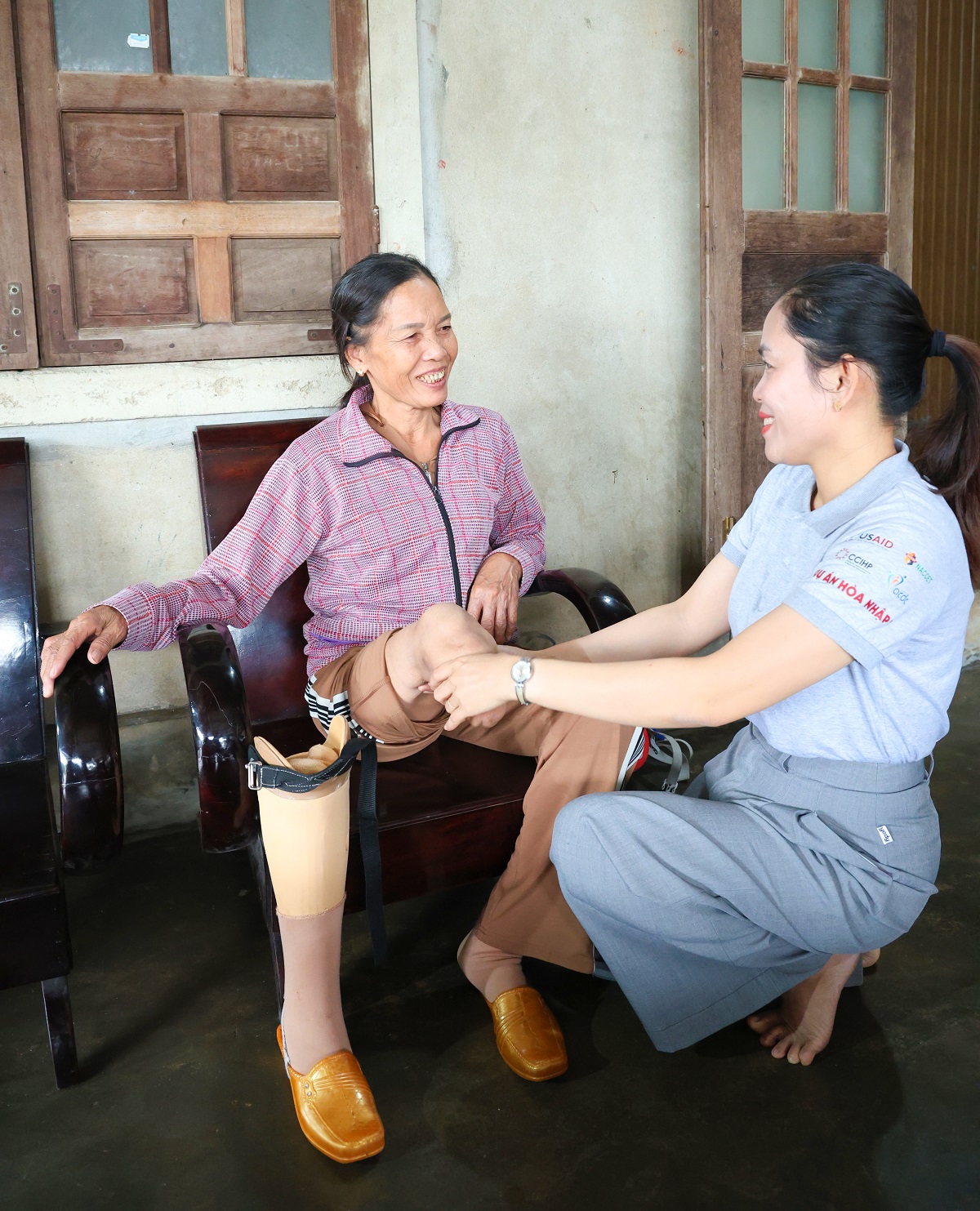
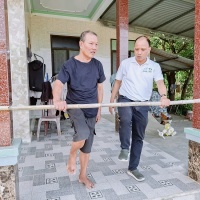
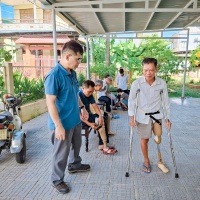
Ms. Dong practicing rehabilitation exercises at home with a rehabilitation technician
For many years, her mobility depended on a prosthetic leg. However, the old prosthesis did not fit her well, making movement difficult and uncomfortable. She recalled: “A few years ago, I was given a prosthetic leg, but it caused pain every time I used it and led to sores on the residual limb. Still, I had to keep using it because I had no other way to walk.” Over time, her health declined due to prolonged improper gait. She frequently experienced lower back pain, pain in her left knee, a noticeable lean to the right, and a high risk of falling on uneven ground.
Her life began to change in 2024 when the Inclusion 1 Project, implemented by the ACDC Institute, conducted screening and rehabilitation support activities for persons with disabilities in her community. Through the screening and needs assessment process, a multidisciplinary rehabilitation team (MDT) identified her as a beneficiary for rehabilitation intervention.
Mr. Nguyen Van Nam, a project officer, shared: “The project conducted screening and needs assessments for persons with disabilities. Based on the MDT’s evaluation, we selected Ms. Dong to participate in the rehabilitation intervention program.”
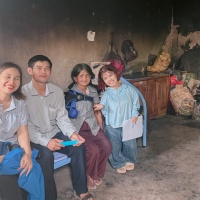
After being selected, Ms. Dong received comprehensive support from the project. Rehabilitation doctors and technicians visited her home to assess her mobility and guide her through appropriate exercises. This was also the first time in many years that she had access to structured rehabilitation training. She shared: “Since the accident, I had never done any exercises. Only when the project came did I receive proper training for the first time.”
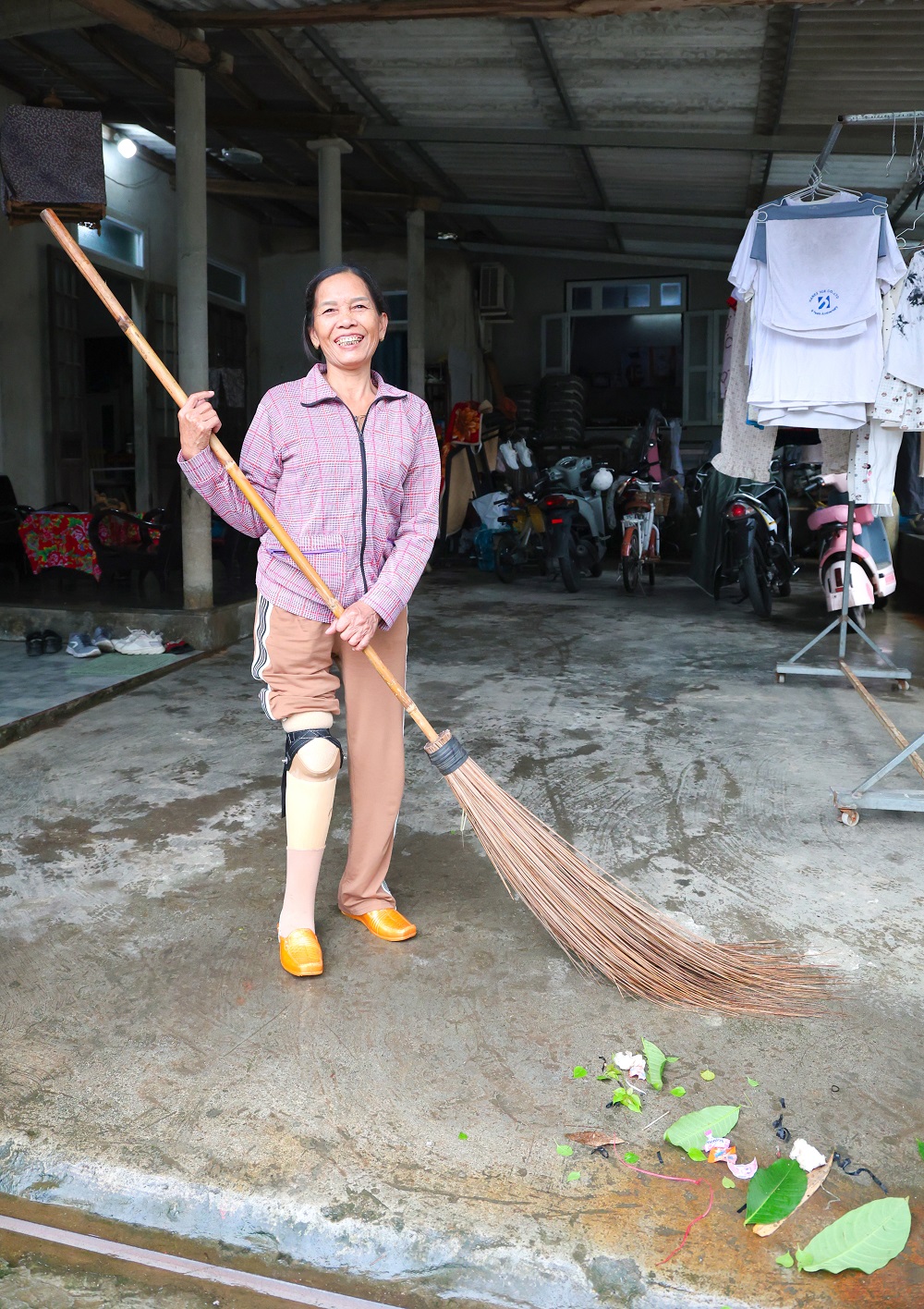
Ms. Dong happily stands with the prosthetic leg supported by the project
In addition to home-based rehabilitation sessions, the project also supported her in accessing more suitable assistive devices. The team collaborated with the Rehabilitation Hospital in Da Nang to design a prosthetic leg tailored to her condition. Measurements were taken at her home, followed by three fitting sessions before the final prosthesis was completed and provided. . After receiving the new prosthetic leg, project staff continued to visit her to guide safe use and practice. In total, she received multiple sessions on using assistive devices along with rehabilitation exercises at home.
Clear improvements began to emerge after the intervention. Ms. Dong shared that walking had become much easier and more comfortable. “With the new leg, there is no more pain. I can walk straight and properly.” The rehabilitation exercises also significantly reduced the discomfort she had experienced before. She said: “The project team came to train me eight times. Before, my leg and back hurt a lot, but now it’s much better. I can walk properly. I’m very happy.”
The changes were not only felt by her but also noticed by those around her. She smiled as she shared: “With the new prosthetic leg, I feel much more comfortable. Neighbors say I walk much better now, no longer lean to one side.”
Now, moving around her home and neighborhood has become easier. She is more independent in daily activities and continues caring for her family and grandchildren with a more positive and relaxed mindset.
For Ms. Dong, the new prosthetic leg is not just an assistive device. It is a source of support that helps her walk steadily after many years of challenges. Most importantly, it brings a sense of being cared for and supported at the right time, helping her move through life with greater ease and confidence.